SMS Kurfurst Friedrich Wilhelm / Barbaros Hayreddin
The first battleship of the Imperial German Navy to fire its guns in anger, but in the service of the Ottoman Empire, not the Kaiser. Spent 6 years as flagship of the Imperial Navy, and then deployed to suppress the Chinese Boxer rebellion. Sold to the Ottomans and provided naval gunfire support to the Turkish defenders at Gallipoli, only to become the first and only battleship to be sunk by a British submarine.
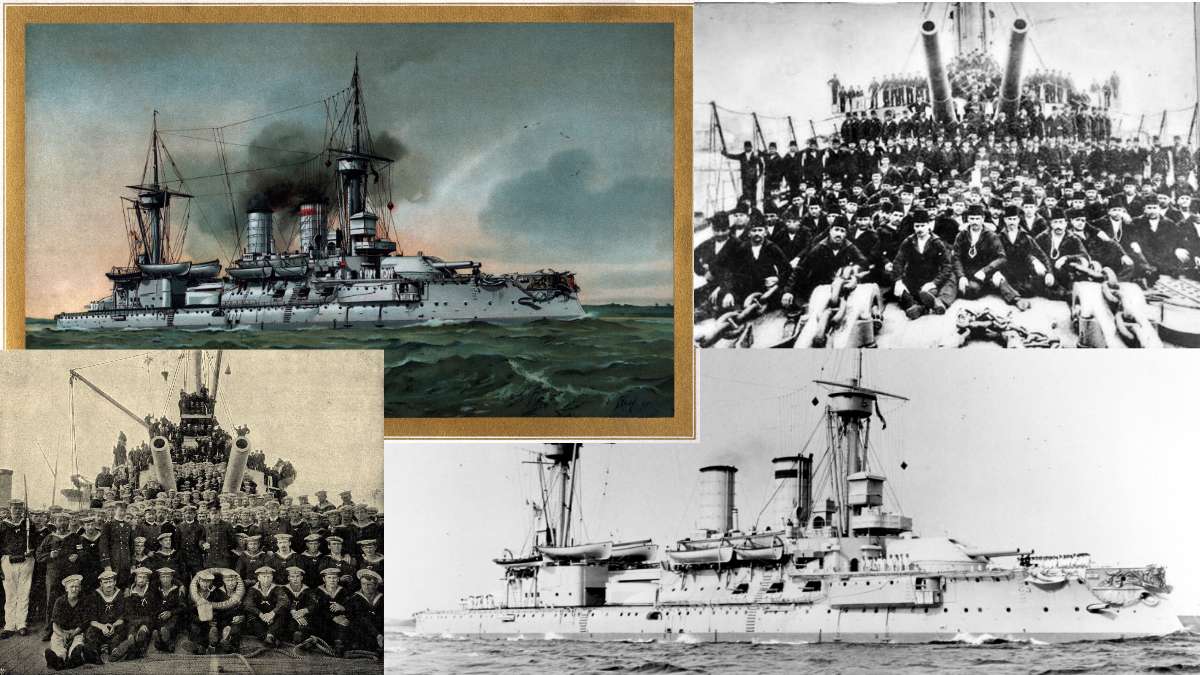
The four ships of the Brandenburg class were built between 1890 and 1894. They were the first German pre-Dreadnoughts, with an unusual main armament of six heavy guns in three centreline turrets but a much lighter secondary armament than contemporary battleships. They were successful ships heavily influenced by French designs - good sea boats and fast at 16 knots. The high superstructure, pronounced tumble home and military masts gave them a pugnacious look. SMS Kurfürst Friedrich Wilhelm was the third to be completed and named after the the 17th century Great Elector of Brandenburg. This was the second battleship named for him; the first was the unlucky SMS Großer Kurfürst which was sunk by accidental ramming in 1878 (see A Ramming off Folkestone). The Kurfürst Friedrich Wilhelm was fleet flagship from 1894 to 1900, when two future commanders of the High Seas Fleet served aboard (Reinhard Scheer and Franz Hipper). The flagship’s routine of exercises and ceremonial was interrupted in July 1900 when the whole class was sent to China to suppress the Boxer rebellion, which remains the furthest deployment of any German battleship. By the time they arrived in East Asia, there was nothing for them to do and they returned home in August 1901.
In 1910, the Turks were seeking to expand their navy ahead of an anticipated war with Greece. They needed to counter the brand new Greek armoured cruiser Georgios Averoff and asked to buy the equivalent German cruiser Blücher. The Kaiser agreed, provided the ship was crewed by Germans, but the Turks could not meet the cost of 44 million Marks. Attempts to buy a battlecruiser under construction direct from the shipbuilders Blohm & Voss were vetoed by Admiral von Tirpitz. In the end, the Kaiser offered them the Brandenburg class. The Turks could afford only two, and selected Kurfürst Friedrich Wilhelm and Wießenburg, the two ships of the class with the more modern Krupp nickel steel armour. The cost, of 17 million Marks, was met by contributions from the civilian Turkish Naval Society and the seized funds of the deposed Sultan Abdul Hamid held by Germany. They were old but well maintained and recently extensively modernised; in theory, they would be a match for the Georgios Averoff. They arrived in Istanbul on 29 August 1910 and the Kurfürst Friedrich Wilhelm was renamed Barbaros Hayreddin when officially transferred on 1 September 1910. Hayreddin Barbarossa was the renowned corsair and grand admiral of the Ottoman Navy in the sixteenth century who established Ottoman maritime supremacy in the Mediterranean for Sultan Suleiman the Magnificent.
Although they kept them spick and span, the Turks lacked the resources, technology and infrastructure to maintain such large warships. By the time the First Balkan War broke out in October 1912, their boilers were troublesome, limiting their speed to no more than 12 knots, their rangefinders had been removed and the watertight doors no longer fitted correctly. Nevertheless, they sortied out to bombard Bulgarian army positions at Varna on the Black Sea on 19 October 1912. The ships were unsuited to this task and their fire ineffectual, so they returned to Istanbul. This action was the first time that any German battleship had fired its guns in anger since the formation of the Kaiserreich in 1871.
On 16 December the Turkish fleet, with Barbaros Hayreddin as flagship, emerged from the Dardanelles to fight the Greeks. The much faster Georgios Averoff outmanoeuvred the lumbering battleship and caused minor damage to the stern of Barbaros Hayreddin, disabling the rear turret. The Turks, now down to only 10 knots, turned away in some confusion and retreated to the cover of their own coastal guns. On 10 January 1913 the Turks sallied towards Imros again, causing the Greeks to withdraw after a few rounds of gunfire were exchanged. Ten days later the Turkish battleships emerged for the third and last time. Again, the faster Greek armoured cruiser had the better of the fight, hitting the central turret of the flagship and killing all the crew. The smoke was sucked into the engine room of the Barbaros Hayreddin and the ship was forced to withdraw once again at only 5 knots towards the shelter of the shore batteries at Kumkale.
At the start of the First World War, the Germanophile Enver Pasha pledged Ottoman support to the Germans. The fleet came under the control of the German Konteradmiral Souchon. The battleships were in poor condition, but there was time only to repaint them and provide them with coal and ammunition. In November 1914, the French and British declared war on Turkey and in February 1915 they started naval action to force the Dardanelles - an attempt that failed ignominiously on 18 March 1915. Having learned the lessons of Varna in 1912, the Barbaros Hayreddin and Torgud Reis (formerly Wießenburg) had been static floating batteries in the Dardanelles since 18 February. When enemy troops landed in Gallipoli on 25 April 1915 the battleships provided immediate fire support to Turkish forces, despite a premature detonation in Barbaros Hayreddin after 15 rounds which destroyed one gun in the midships turret. This support continued at the rate of about 30 rounds per day until another shell exploded in the forward turret of Barbaros Hayreddin on 5 June, killing 4 gunners - the ship withdrew to Istanbul the same day.
When the British landed more troops at Suvla Bay on 7 August 1914, the Turkish army demanded the battleships return. British submarines were now known to be operating in the Sea of Marmora, but with misgivings Souchon agreed to send the Barbaros Hayreddin to assist. The ship, now commanded by German Korvettenkapitän Lorey, was found by Lieutenant Commander Nasmith commanding the submarine E11 at five in the morning of 8 August off Bulayir. The single torpedo fired caused the ship to capsize and sink after seven minutes - 258 crewmen died. The Barbaros Hayreddin, formerly SMS Kurfürst Friedrich Wilhelm, was the only battleship to ever be sunk by a British submarine.
Links
References
Dodson, A, The Kaiser’s Battlefleet: German Capital Ships 1870-1918, Seaforth Publishing, 2016. pp. 37-40, 189
Gröner, E, D Jung, & M Maass, German Warships, 1815-1945, Conway Maritime Press, 1990. pp. 13-14
Hildebrand, H H, Röhr A, Steinmetz H, Die deutschen Kriegsschiffe : Biographien; ein Spiegel der Marinegeschichte von 1815 bis zur Gegenwart, volume 4, Heoford Koehler, Herford, 1985 [in German]. pp. 45-55
Langensiepen, L, Güleryüz, A, The Ottoman Steam Navy 1828-1923, Conway Maritime Press. pp. 17, 20, 22-24, 28, 33
Picture credits
Taken from Wikimedia commons, all public domain
SMS Kurfürst Friedrich Wilhelm


Taken from Picryl, public domain
Taken from Reddit, public domain