August von Heeringen
In 1897, Korvettenkapitän August von Heeringen was chosen by Konteradmiral Tirpitz to play a key role in creating the German battle fleet which kicked off a naval race with Britain. In 1912, when Germany had lost that race, the then Vizeadmiral von Heeringen was faced with the insuperable problem of how to win a war with the fleet that Tirpitz built.
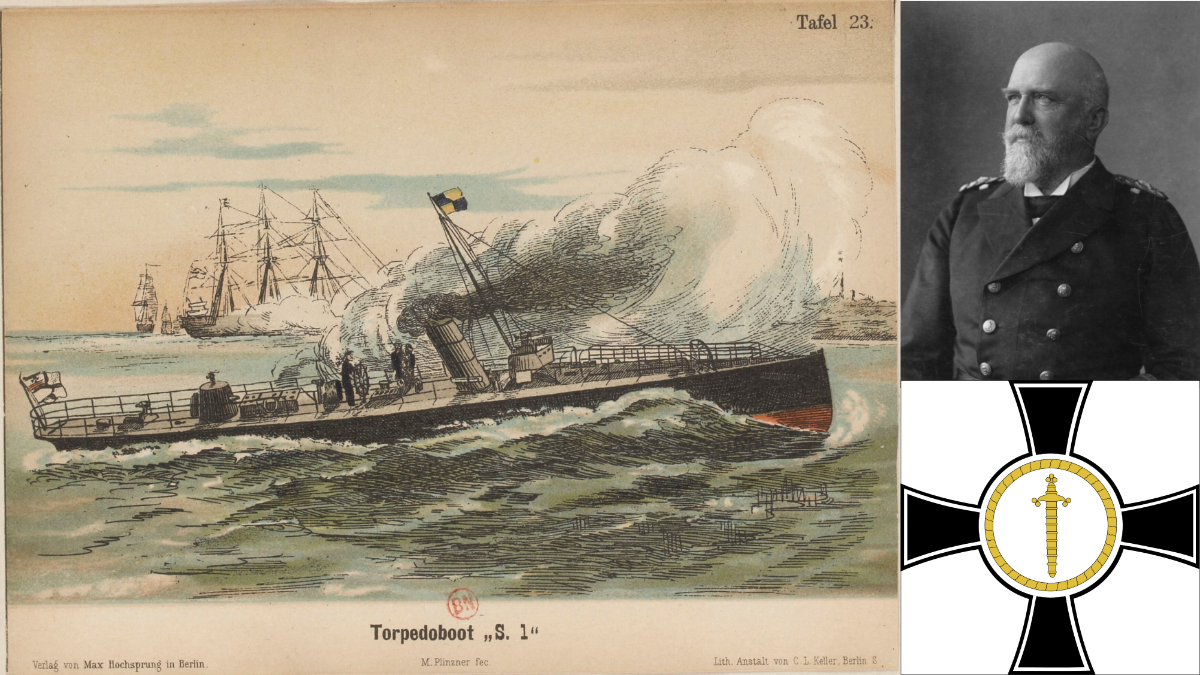
On the night of 27 September, 1874 the 28 year old Leutnant zur See August Amon von Heeringen, commanding an experimental Schichau built torpedo boat, was facing disaster in the Skagerrak west of Jutland. The rudder of his light weight 37 metre boat, which had been damaged in a collision a few days ago, was failing. A force nine south south westerly gale was brewing and the seas were rising ominously.
Heeringen was one of the young officers known as “The Torpedo Gang”, led by Korvettenkapitän Alfred Tirpitz, whose task was to develop this novel wonder weapon of the 1880s. Tirpitz, in the corvette Blücher and with three other torpedo boats in company, was facing a severe test of his preferred concept of high seas torpedo boats able to accompany the fleet. He had already decided to take his flotilla to sea in the face of the gathering storm despite the improvised repairs carried out to Heeringen’s rudder. Now, when Heeringen signalled his rudder had failed, the determined Tirpitz would not turn back. He boarded Heeringen’s boat in the darkness and heavy seas, intending to assist in manually rigging a jury-rudder. In the storm, Heeringen and his boss were separated from the rest of the flotilla which had to run for safety to Kristiansand in Norway. Come the morning, it was thought the tiny torpedo boat might have foundered in the storm. Eventually, 24 hours after last being seen, Heeringen reported in by telegram; he and Tirpitz had brought the boat through the storm to Fredrikshavn in eastern Jutland. Their triumph became famous as “storm night”, and cemented the torpedo boat crew’s reputations as “Sea Cossacks”, with a vindicated Tirpitz as their Hetman. This joint struggle against the storm was the foundation of a career long friendship and professional partnership between Tirpitz and Heeringen.
In 1897, Tirpitz became the State Secretary of the Imperial Naval Office. He had a plan to renew and expand the German battle fleet, while entrenching his own bureaucratic control of the Kaiserliche Marine. The Naval officer corps liked the idea of more prestige and job opportunities; the military industrialists saw more profit, and the Kaiser treasured his navy as a personal plaything with which to impress his English royal relatives. Only the German parliament, the Reichstag, needed convincing, for they were the people who would vote the necessary money. Tirpitz needed a loyal propagandist and he chose exactly the right man - Korvettenkapitän von Heeringen. Heeringen employed his aristocratic status, immense energy and personal charm on both the Reichstag members and their voters. The navalist works of the American writer Mahan were translated; retired senior officers were wheeled out to speechify and write articles; journalists and Reichstag members were entertained and invited to naval exercises at sea. An independent Naval League was formed and encouraged to lobby for more ships. The German Colonial Society and the Pan-German League were deployed to strengthen the case. Dozens of prominent professors were recruited to explain Germany’s maritime interests. Model warships could be bought in the shops next to cigarette and chocolate packets plastered with ships and sailors. Heeringen even sent a division of torpedo boats over 250 miles up the Rhine to impress the citizens of Karlsruhe. His campaign was supposed to be discreet, but many parliamentarians knew who was pulling the strings. Regardless of this, their voters and lobbyists were now all for the Navy and whatever it said it needed. In 1900, the Reichstag voted the Navy a 38 ship battle fleet, enough to challenge the pre-eminent naval power of the age - Great Britain.
The ensuing Anglo-German naval race was a major contributory cause of the First World War. By 1912 the Germans had lost, out built and outnumbered three to two. Geography was against them, bottled up as they were in the south east corner of the North Sea. At this point, now Vizeadmiral von Heeringen was appointed Chief of the Admiralty Staff with explicit responsibility for war planning. Heeringen was realistic, canny and well informed. He understood that the arguments for constructing a “risk fleet” with “alliance value” that were used between 1897 and 1900 were mere propaganda smoke and mirrors. Heeringen wargamed taking the battle to the British, which did not go well - “I fear that our fleet is too small to win and too big to die gloriously”. He was aware that sitting inactive in the fleet base at Wilhelmshaven would be fatal to morale and the Navy’s reputation. He adopted the only acceptable plan - use mines, submarines and raids to whittle down the British fleet as it blockaded the Heligoland Bight until a favourable attacking opportunity arose. But the British did not need to oblige by mounting such a close blockade. If they bottled up the narrow Dover Strait and stationed their Grand Fleet at the northern exit from the North Sea, 600 miles from the Wilhelmshaven, they would win the war by strangling German trade and without a fleet battle. Heeringen knew that the assumptions of his war plan were flawed -
“If the English really adopt a distant blockade, with a consequent holding back of their battleships, the wartime role of our beautiful High Seas Fleet will be a very unhappy one. The U-boats would then have to [carry on the war].”
In the event, this was exactly what happened.
Two months before the First World War broke out, von Heeringen retired as a full Admiral. His debilitating angina and hardening arteries ruled him out of command of the High Seas Fleet. That task fell successively to three other members of the Torpedo Gang - Friedrich von Ingenohl, Hugo von Pohl and Reinhard Scheer - none of whom were able to solve the problem Heeringen identified. But he lived to see the downfall of both the fleet he helped create and of his leader, friend and mentor, Alfred von Tirpitz.
Links
Wikipedia article on von Heeringen
Wikipedia article on the German Naval Laws
References
I have relied heavily on Patrick Kelly’s excellent biography of Tirpitz. The quotations from Heeringen are as given in that book.
Kelly, P J, Tirpitz and the Imperial German Navy, Bloomington, 2011. pp 58-59, 67, 136, 363-364
Picture credits
The main picture is of the type of torpedo boat that Heeringen commanded in 1884, rendered as a lithograph, a medium that was later used by Heeringen in his propaganda campaign. The photographic portrait is Heeringen in 1913 or 1914 as Chief of the North Sea Station. The flag is that of the Chief of the Admiralty Staff.
Lithograph by M Plinzner, 1890
.jpg)
von Heeringen photo from German Federal Archives B134-B2754 Licence
