SMS Baden (1880)
A German ironclad coast defence ship of the 1870s which served as a fleet flagship for twenty years, well into the pre-Dreadnought era.
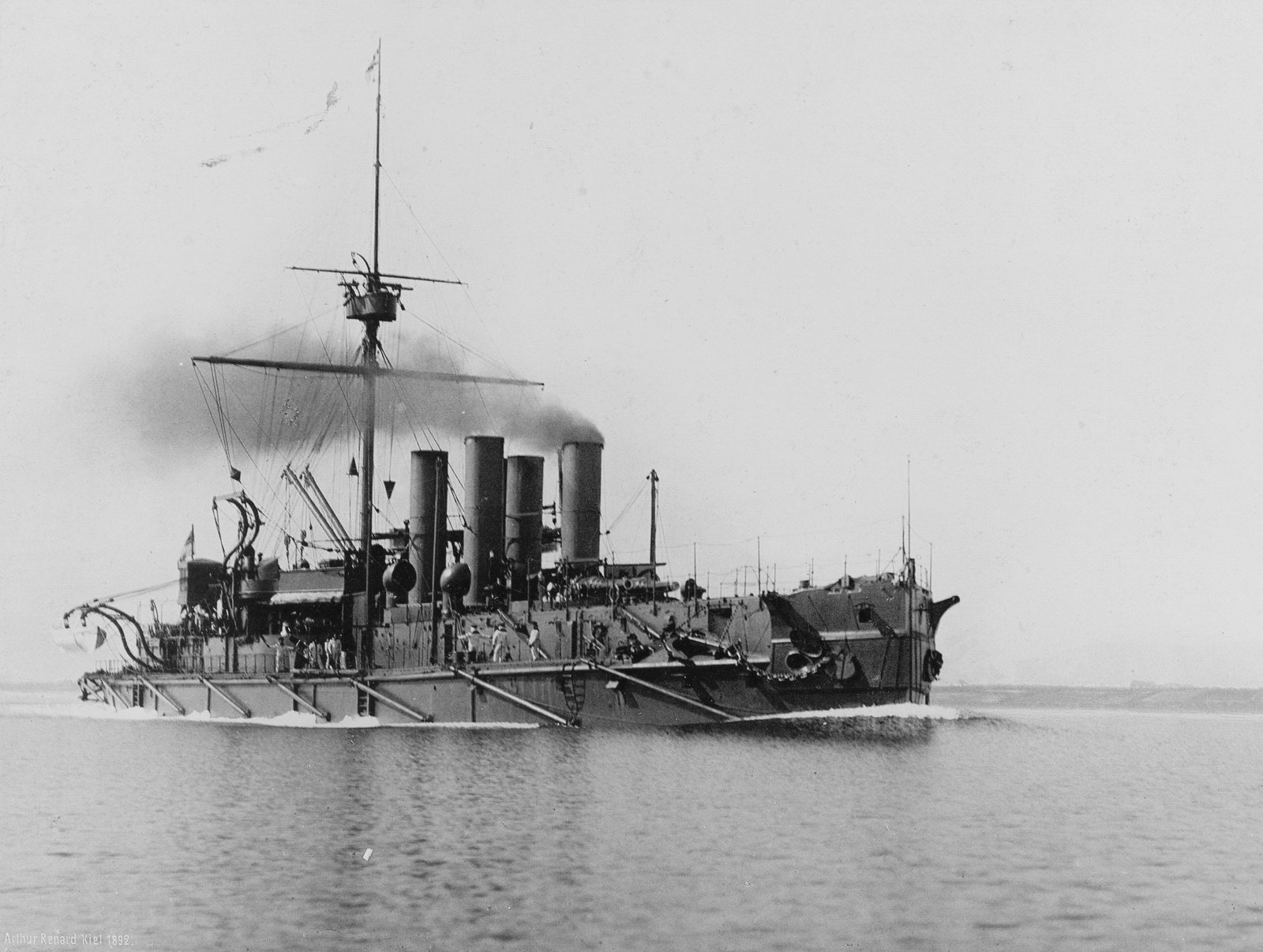
The first head of the Imperial German Navy (the Kaiserliche Marine, or KLM) was a General of Infantry in the Prussian Army, Albrecht von Stosch. He energetically set about organising and expanding the nascent KLM, and in 1873 came up with a fleet plan which bore his name and formed the basis of development for many years. One task of the navy was coastal defence, which Stosch arranged to his own perfect satisfaction: the sea borders of Germany were to be studded with railway connected fortified ports manned with troops, from which armoured warships would sally forth into the littoral waters to break the maritime sieges laid by enemy navies. The four ships of the Sachsen class, of which Baden was the last, were the centrepiece of this strategy. Known as Ausfallkorvetten, sortie corvettes, they were large, low freeboard ironclads mounting six big guns in open barbettes and completed between 1878 and 1883. Complemented by the 11 heavily armoured gunboats of the Wespe class, they were part of a systematically thought out integrated coastal defence system.
Unfortunately, whatever the merits of this distinctly non-Mahanian concept, the execution fell well short in practice. The German shipbuilding industry was inexperienced in building modern warships, with the launch of Baden being delayed by two years to fix the problems discovered in the first three ships. They were clad with wrought iron armour just at the point when much more effective compound armour was being introduced in Britain and France. The engines were unsatisfactory, the ships slow, and their draught too great to allow work inshore. Their flat bottoms caused them to roll excessively in a beam sea and made them terrible gun platforms. The six big guns themselves were good Krupp 26cm calibre breech loaders but were mounted in barbettes with no crew protection. The four tall funnels arranged in a square immediately in front of the conning position, itself well aft, gave them a strange, unbalanced look, and they gained the nickname “cement factories”. An unkind sailor might be forgiven for thinking that the Baden was exactly the sort of ship that he would have expected from a General of Infantry.
Despite these disadvantages, the Baden and its class mates became a mainstay of the KLM battle fleet for nearly 20 years. In nine of its first sixteen years of service, Baden was the fleet or a divisional flagship for the annual fleet manoeuvres, notwithstanding being completely obsolete in Great Power navy terms. Between 1895 and 1899, the whole class was given new Krupp steel armour and new engines with a single towering funnel, though an extra knot of speed still only gave them a sedate 14 knots. Their big guns were unchanged and they remained poor sea boats, unable to operate beyond the Baltic and North Seas and no match for even the smallest modern armoured cruiser. Nevertheless, Baden was again a flagship for four more annual manoeuvres. Finally, in 1910, the Baden was struck from the navy list, though it gave another 28 year’s service as a mine training hulk, accommodation ship and latterly target ship until scrapping in 1939.
In all the years of training exercises, state visits and escorting the Kaiser’s yacht, the Baden became a well known fixture of the fleet. Despite never getting further than Portsmouth, Oslo and St Petersburg, the ships of the battle fleet, often led by Baden, were the training ground and nursery of the German officers who lead the High Seas Fleet into the Great War. The fleet handling developed in the 1890s, long after Stosch had retired, laid the foundations of German tactics at Jutland.
Links

References
Dodson, A, The Kaiser’s Battlefleet: German Capital Ships 1870-1918, Seaforth Publishing, 2016. pp 25-26, 184
Gröner, E, D Jung, & M Maass, German Warships, 1815-1945, Conway Maritime Press, 1990. pp 7-8
Sondhaus, L, Preparing for Weltpolitik: German Sea Power Before the Tirpitz Era, US Naval Institute Press*, 1997. pp 113, 135-136