A Ramming Off Folkestone
In the summer of 1878, two German ironclads collided off the Kent coast, sending over 250 sailors to their deaths as SMS Grosser Kurfürst went to the bottom. The disaster led to four courts martial, a loss of confidence in the Kaiserliche Marine and a withering away of the German battle fleet.
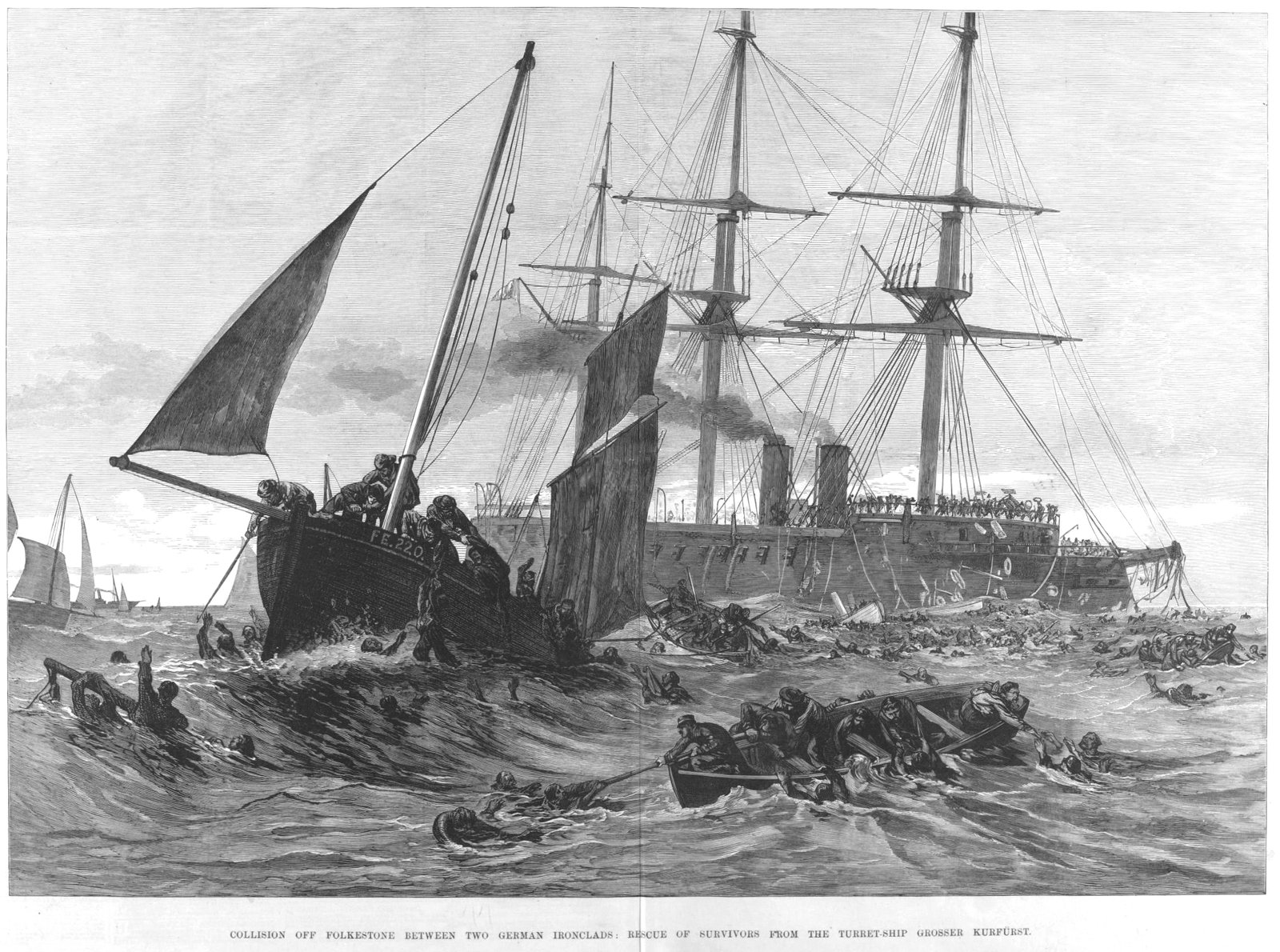
On the morning of Friday, 31st May 1878, Lieutenant Rudyerd was supervising his soldiers at rifle practice on Sandgate beach, near Folkestone. The weather was clear and sunny, with a light easterly breeze and a calm sea. He took a break to take in the splendid sight of three German ironclads steaming westward up the English Channel within two miles of the beach. Crossing their bows were a pair of merchant sailing barques on the port tack and he watched as the two leading ironclads turned to starboard to pass behind them in accordance with the ‘rule of the road’. The manoeuvre was poorly executed, and Rudyerd could see the two warships coming dangerously close. Their efforts to avoid collision failed, and the flagship König Wilhelm inadvertently executed a textbook ramming attack on its consort, the brand new turret ironclad Großer Kurfürst. In a vain attempt to avoid the collision, the turret ship’s engine was at full speed ahead, so the flagship’s ram ripped a gash from the impact point between main and mizzen masts all the way to the stern. Within eight minutes the Großer Kurfürst sank in a cloud of steam from its exploding boilers; 276 officers and men were killed in the disaster, over half the crew. Unable to assist, all Rudyerd could do was sketch the scene with his trained military eye, drawings which were later used in The Illustrated London News account of the event.
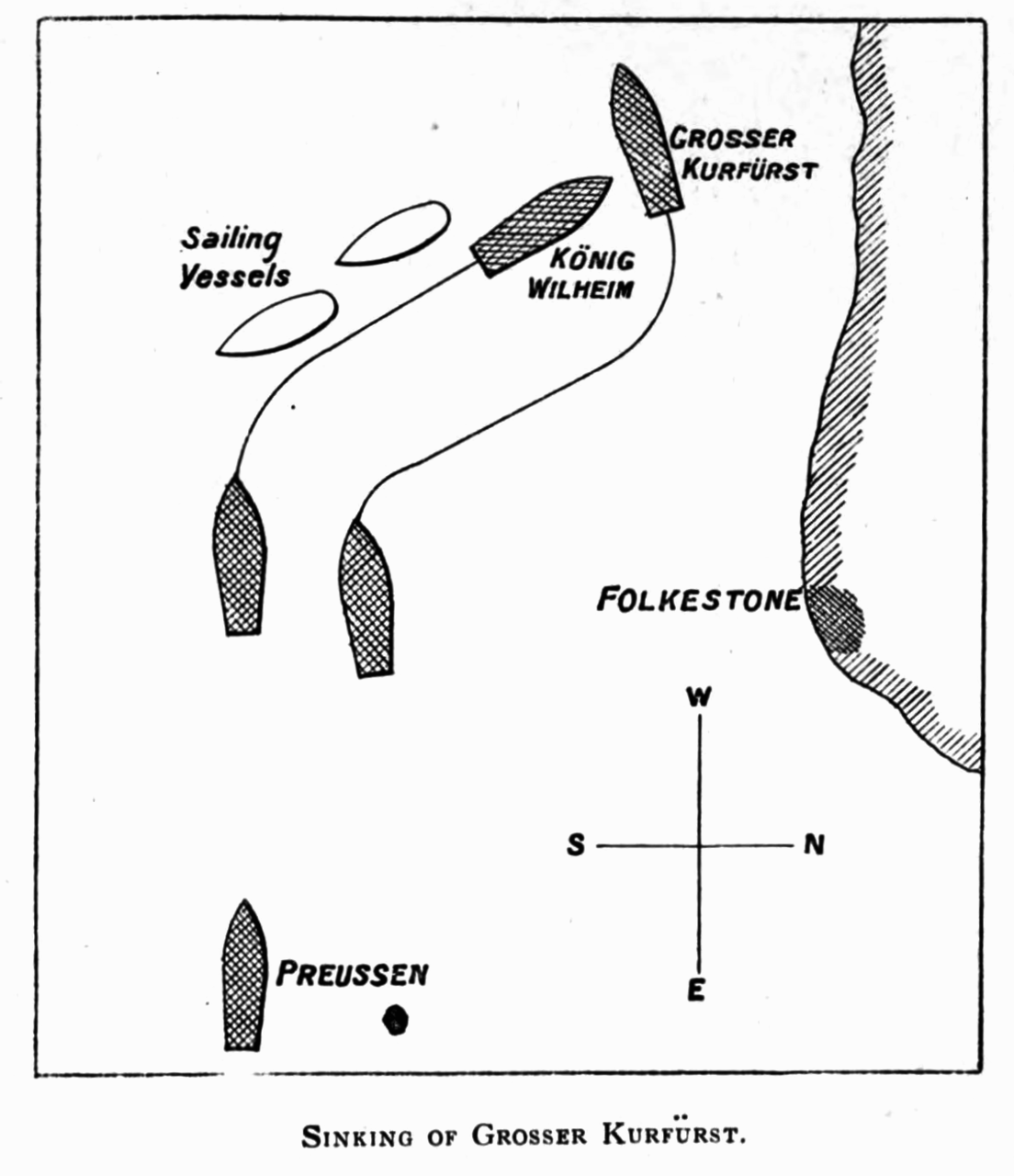
The large ironclads of the time had single screws, slow response steam engines and a lot of inertia. Homogenous classes were rare, making handling of mixed squadrons tricky. Collisions were not uncommon and most ships were fitted with strengthened rams for use in battle. For these reasons, the British Royal Navy usually kept a distance of 400 yards, two cables, between columns of ships in company; the German standard was much closer at one cable. The newly commissioned ships of Konteradmiral Batsch’s squadron were unfamiliar with each other, having set out from Wilhelmshaven only three days before. Nevertheless, the admiral chose to make a close pass of Dover harbour mole and reduced the separation between his two columns to half a cable, less than a ship length. Kapitän zur See Graf von Monts of the Großer Kurfürst was concerned enough by this decision to personally take the con of his brand new and untried ship. When the squadron approached Folkestone they were still at this distance, with the Großer Kurfürst inshore and slightly abaft of König Wilhelm. By taking a course close to the shore, Batsch was showing off his ships, but also mixing with local traffic. With little room to manoeuvre, the squadron’s attempt to avoid the sailing ships went awry. They almost got away with it - the flagship was looking to scrape astern of the Großer Kurfürst until its flustered officer of watch, Kapitänleutnant Klausa, gave a confusing order to the inexperienced helmsman, who turned the wheel the wrong way. The subsequent fatal collision changed the fortunes of the Kaiserliche Marine for a decade.
The Chief of the Admiralty, General von Stosch, immediately ordered an enquiry by three naval captains at Kiel, supervised by Konteradmiral Werner, the head of the Baltic Station. They laid the blame firmly on Batsch for hurrying his squadron to sea and then ordering over ambitious close-order manoeuvring before shaking down his ships. Monts stated his crew were unprepared, his ship had been completed only 25 days ago, still had dockyard contractors on board and suffered from an unreliable rudder - the enquiry exonerated him. Alas, this was not the answer Stosch wanted, for Batsch was his protege. Nor did Stosch like the criticism of his unpopular policies, such as using the limited time available in winter to train conscripts in pointless square bashing and allowing captains only eight days to work up their ships companies as if they were army units. Stosch saw Werner as the focus of naval opposition, so he ordered him to resign. He then convened a naval court martial to try Batsch, Monts and Klausa; this came up with the wrong answer by confirming the result of the enquiry. Undeterred, he convinced Kaiser Wilhelm I that the court was biased against Batsch. A second court martial by the army in Berlin sentenced Monts and Klausa to prison for their actions while acquitting Batsch; at last, this was a result that pleased Stosch. But the Kaiser was unhappy and ordered a third trial. The outcome was reversed, with Batsch and Klausa receiving jail time and Monts being acquitted. Finally, Monts was tried alone for not ensuring the watertight doors of his ship were closed - he was exonerated yet again. Batsch served two months in prison in Magdeburg fortress before the Kaiser commuted his sentence and promoted him to Vizeadmiral.
The German parliament, the Reichstag, was deeply unimpressed by the whole affair. They were responsible for voting the tax money to pay for the navy’s ships. The Großer Kurfürst cost 7.3 million Marks and served for a mere three weeks before being lost through obvious incompetence with great loss of life. The infighting between General Stosch, who had never served at sea, and his insubordinate admirals did not help, nor did the fiasco of the repeated courts martial. The Reichstag lost confidence in Stosch, slashed the naval budget and subjected every request for funds to close scrutiny. When the damaged Stosch finally resigned after struggling on to 1883, he recommended his protege Batsch as successor, having eliminated all possible naval alternatives. But the Kaiser could not overlook the Großer Kurfürst affair and the prison time of Batsch - he appointed another General. Leo von Caprivi was, if anything, more rigidly authoritarian than Stosch and even less interested in what the naval officers had to say about how the service should be run. Convinced that war was always coming the day after tomorrow, he refused to acquire any ships that took more than 12 months to build. This lack of replacement, combined with Reichstag stinginess, resulted in the battle fleet withering away on the vine. By 1888, when Kaiser Wilhelm II came to the throne, the Kaiserliche Marine was fit only for coastal defence and showing the flag in the recently acquired colonies.
Links
The Wikipedia account of the collision
The text of the Illustrated London News article of 8 June 1878
References
Dodson, A, The Kaiser’s Battlefleet: German Capital Ships 1870-1918, Seaforth Publishing, 2016. pp. 26, 180, 182
Hildebrand, H H, Röhr A, Steinmetz H, Die deutschen Kriegsschiffe : Biographien; ein Spiegel der Marinegeschichte von 1815 bis zur Gegenwart, volume 3, Heoford Koehler, Herford, 1985 [in German]. pp. 29-31
Sondhaus, L, Preparing for Weltpolitik: German Sea Power Before the Tirpitz Era, US Naval Institute Press, 1997. pp. 125-135
Wilson, H W, Ironclads in Action: A Sketch of Naval Warfare, vol. 2, Sampson Lowe, Marston and Company, 1896. pp. 192-195
Picture credits
Collision off Folkestone, England, between Two German Ironclads, Rescue of Survivors from the Turret-Ship Grosser Kurfurst. An illustration for The Illustrated London News, 8 June 1878, extra supplement.

The ship shown is the damaged König Wilhelm, while the fishing boat is the Emily Richard of Folkestone. I suspect that the artist has exaggerated the sea state for dramatic effect.
The plan is taken from Wilson’s account.